Smart Buildings Market Forecast for Nonresidential Buildings: Segment Analysis, Industry Trends, and Strategic Insights
The Business Research Company's Smart Buildings (Nonresidential Buildings) Market Report 2026 – Market Size, Trends,
Press Release Disclaimer: This is a press release distributed through the XPR Media network. It has not been independently verified by our newsroom.

The Business Research Company’s Smart Buildings (Nonresidential Buildings) Market Report 2026 – Market Size, Trends, And Global Forecast 2026-2035
LONDON, GREATER LONDON, UNITED KINGDOM, October 13, 2026 /EINPresswire.com/ — “The landscape of smart buildings in nonresidential construction is rapidly evolving, driven by technological advancements and growing demand for efficient, secure, and automated infrastructure. This sector is becoming a vital part of the larger construction industry, with substantial growth prospects as businesses and institutions seek smarter solutions to manage energy, security, and building operations.
Market Size and Growth Forecast for Smart Buildings (Nonresidential Buildings)
The smart buildings market for nonresidential structures is expected to surpass $141 billion by 2030. This segment forms a part of the broader Nonresidential Building Construction market, which is projected to reach roughly $3,721 billion by 2030, with smart buildings accounting for about 4% of this total. When viewed within the entire Construction industry, anticipated to hit $21,691 billion by 2030, smart buildings will make up nearly 1% of the overall value.
Request A Free Sample Of The Smart Buildings (Nonresidential Buildings) Market Report
https://thebusinessresearchcompany.com/sample_request?id=58900575&type=smp&name=Smart%20Buildings%20%28Nonresidential%20Buildings%29%20Market%20Report%202026&utm_source=EINPresswire&utm_medium=Paid&utm_campaign=Oct_PR
Key Highlights Defining the Smart Buildings (Nonresidential Buildings) Market
By 2030, the smart buildings market will grow at a robust compound annual growth rate (CAGR) of 13%, with Asia-Pacific emerging as the largest regional player. In 2025, VINCI S.A. is expected to hold the leading position with a 2% market share, and the top 10 companies collectively will command 22% of the market.
Primary Drivers Catalyzing Growth in Smart Buildings Market
One major growth factor is the increased adoption of building energy management systems (BEMS). Property owners are implementing intelligent platforms to regulate HVAC, lighting, ventilation, and power usage, aiming to boost efficiency and comfort. The push toward green building standards, rising energy costs, and corporate sustainability targets are all reinforcing this trend. BEMS adoption is anticipated to contribute approximately 3.0% to annual market growth.
Access The Detailed Smart Buildings (Nonresidential Buildings) Market Report Here
https://thebusinessresearchcompany.com/report/smart-buildings-nonresidential-buildings-global-market-report?utm_source=EINPresswire&utm_medium=Paid&utm_campaign=Oct_PR
Another vital driver is the growing fusion of Internet of Things (IoT) technologies with building systems. Smart sensors, connected devices, cloud computing, and AI-driven analytics enable real-time monitoring, predictive maintenance, and centralized control of building operations. This integration optimizes resource usage and reduces maintenance expenses, contributing about 2.9% to yearly growth.
Additionally, there is a rising demand for advanced security and building automation solutions. Commercial properties are increasingly adopting systems that combine AI-powered surveillance, biometric access, intrusion detection, and visitor management with automated lighting, HVAC, and elevator controls. This convergence enhances safety and operational efficiency while improving occupant comfort and lowering costs, expected to add roughly 2.8% annual growth.
Leading Segment Within the Smart Buildings (Nonresidential Buildings) Market
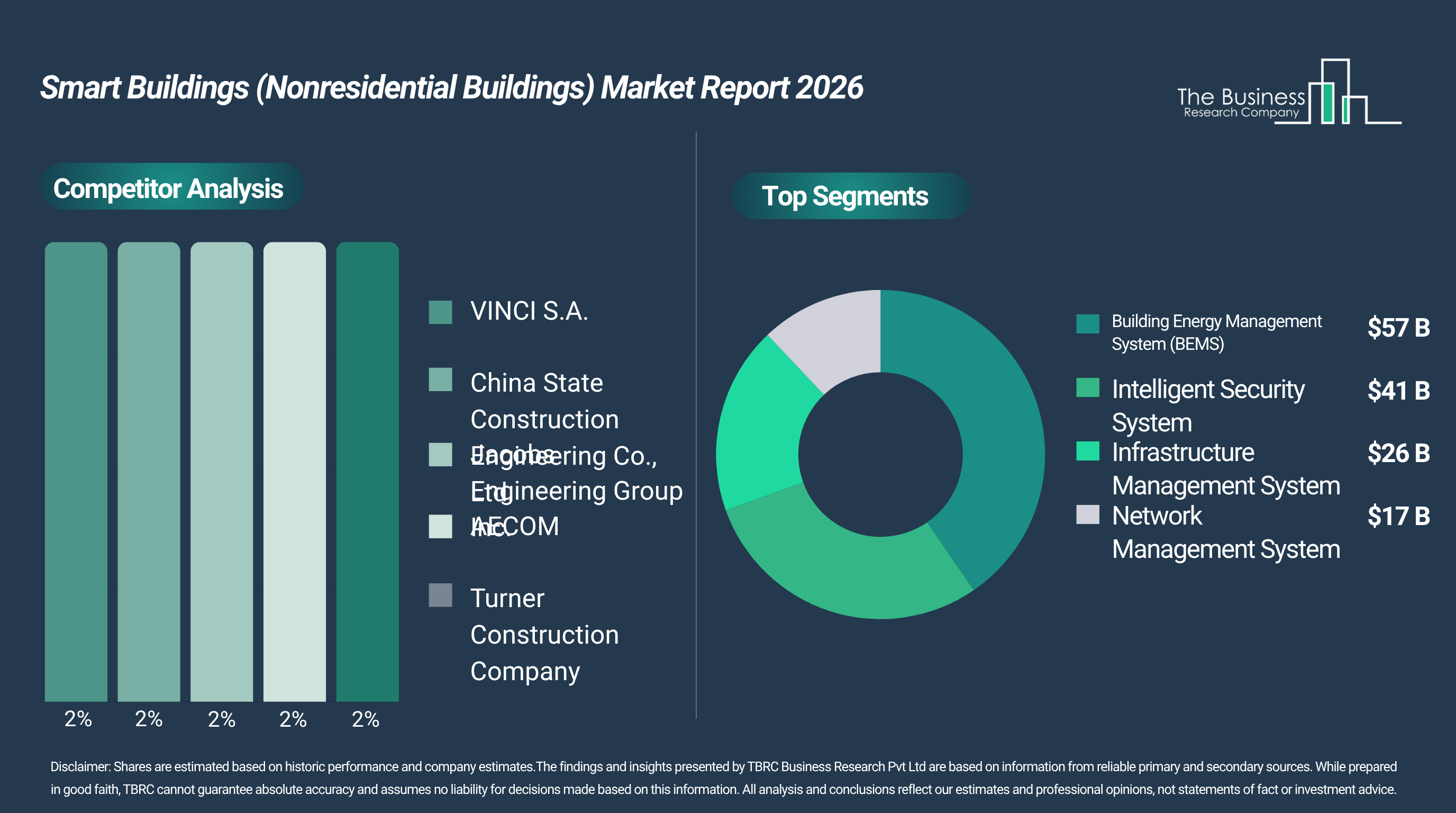
Among automation types, building energy management systems (BEMS) will dominate in 2030, representing 40% of the total smart buildings market or about $57 billion. This segment benefits from features like real-time energy monitoring, automated HVAC and lighting controls, reduced operating costs through intelligent optimization, and AI-enhanced analytics that promote sustainability and performance improvements.
Further Breakdown of the Smart Buildings (Nonresidential Buildings) Market
The market can also be segmented by product type into institutional and commercial buildings. In terms of system type, it covers new construction projects and remodeling efforts. Application-wise, the market includes sectors such as government, airports, hospitals, educational institutions, manufacturing and industrial facilities, along with other use cases.
Regional Dominance and Market Expansion in Smart Buildings
Asia-Pacific is set to lead the global smart buildings market in 2030, with a value of $57 billion, up from $30 billion in 2025. This rapid growth, at a 14% CAGR, is driven by increased investments in smart commercial infrastructures in urban areas, government initiatives promoting sustainable and digitally connected buildings, and widespread adoption of IoT-enabled facility management and energy optimization technologies.
Country-Level Market Insights for Smart Buildings
In 2030, the United States is expected to be the largest single-country market, reaching $36 billion, up from $22 billion in 2025 with an 11% CAGR. Growth in the US will be fueled by modernization of commercial real estate through smart infrastructure, advanced occupancy and space management systems, automated operations that reduce maintenance expenses, and connected technology enhancing productivity and user experience.
Competitive Landscape of the Smart Buildings (Nonresidential Buildings) Sector
The smart buildings market sees competition among global providers of building automation technologies, electrical equipment manufacturers, energy management companies, and digital infrastructure firms. They focus on innovations such as integrated security and access control, AI-powered building management, and IoT-enabled monitoring. Energy efficiency regulations, sustainability goals, occupant comfort, and AI-driven management solutions are key factors shaping their market strategies.
Market Leadership and Share Distribution in Smart Buildings (Nonresidential Buildings)
VINCI S.A. led global sales in 2025 with a 2% share, driven largely by its VINCI energies division, which delivers a broad range of smart building solutions including building automation, energy management, electrical infrastructure, integrated security, and digital technologies across various nonresidential sectors like offices, healthcare, education, and industrial sites.
The market is moderately fragmented, with the top 10 companies generating about 22% of total revenue in 2025. Barriers to entry are moderate, influenced by the complexity of interoperable technologies, strict energy and sustainability regulations, and the need for secure, scalable infrastructures. Leading firms maintain their positions through diversified project portfolios, strong engineering expertise, global delivery capabilities, and ongoing investments in smart building technology.
Top Companies by Market Share in 2025
The leading companies each hold approximately 2% of the market and include: VINCI S.A., China State Construction Engineering Co., Ltd., Jacobs Engineering Group Inc., AECOM, Turner Construction Company, Skanska AB, Larsen & Toubro Limited, Kajima Corporation, Obayashi Corporation, and Bechtel Corporation.
Innovations and Emerging Technologies in Smart Buildings
Artificial intelligence is playing a transformative role by powering integrated building management platforms that increase energy efficiency, optimize operations, and enhance occupant comfort through continuous monitoring and automation. For example, in June 2025, Honeywell International Inc. introduced honeywell connected solutions, an AI-based platform unifying building software and technologies under one interface for nonresidential properties. This platform offers advanced encryption, remote monitoring, predictive maintenance, and energy management capabilities to reduce costs and carbon footprints while fostering safer, more sustainable environments.
Prime Growth Areas Within the Smart Buildings Market
The segments with the highest anticipated growth include building energy management systems, intelligent security systems, infrastructure management, and network management systems. Collectively, these segments are expected to add over $64 billion in market value by 2030. Specifically, BEMS is projected to grow by $27 billion, intelligent security systems by $18 billion, infrastructure management systems by $12 billion, and network management systems by $7 billion between 2025 and 2030. Growth will be propelled by AI-driven building optimization, cloud-based facility management, integrated digital ecosystems, and advanced analytics targeting energy, security, and operational efficiency.
Winning Approaches for Success in the Smart Buildings Industry
Companies are focusing on advancing smart building technologies to boost automation and energy efficiency, leveraging intelligent building systems to optimize performance and occupant comfort, expanding infrastructure to support sustainability and digital capabilities, and integrating AI for improved maintenance and strategic decision-making.
Notable Players Active in the Smart Buildings Market
Key competitors in this sector include VINCI S.A., China State Construction Engineering Co., Ltd., Jacobs Engineering Group Inc., AECOM, Turner Construction Company, Skanska AB, Larsen & Toubro Limited, Kajima Corporation, Obayashi Corporation, Bechtel Corporation, along with others such as PCL Construction, Shimizu Corporation, Taisei Corporation, ACS Group, Balfour Beatty plc, Lendlease Corporation Limited, WBHO Construction, Shanghai Intelligent Building Technology (SIBT), BESIX Group, Royal BAM Group, The Whiting-Turner Contracting Company, Gilbane Building Company, Clark Group, Hensel Phelps, Laing O’Rourke, EllisDon Corporation, Swinerton Incorporated, Ledcor Group of Companies, Arabian Construction Company, Hindustan Construction Company, Redcon Construction Company, Estim Construction Co. Ltd., SGS Group, and Shanghai Construction Group (SCG).
Smart Buildings Market Supply Chain and End User Overview
The supply chain for smart buildings encompasses raw material suppliers such as Siemens AG, Schneider Electric SE, ABB Ltd., Honeywell International Inc., Johnson Controls International plc, Legrand SA, Eaton Corporation plc, Bosch Building Technologies GmbH, Delta Electronics, Mitsubishi Electric Corporation, Carrier Global Corporation, Trane Technologies plc, Cisco Systems, Intel Corporation, Qualcomm, NXP Semiconductors, STMicroelectronics, Infineon Technologies, Analog Devices, Texas Instruments, Murata Manufacturing, TE Connectivity, Belden Inc., CommScope Holding Company, and Hubbell Incorporated.
Wholesalers and distributors include WESCO International, Sonepar Group, Rexel S.A., Graybar Electric Company, Anixter International, Ingram Micro, Arrow Electronics, Avnet, ScanSource, D&H Distributing, ALSO Holding AG, Esprinet S.p.A., Westcon Group, Exclusive Networks SA, Bechtle AG, Redington Limited, Mindware FZ LLC, Logicom PLC, EET Group A/S, Macnica Holdings, RS Group plc, Digi-Key Electronics, and Mouser Electronics.
Key end users consist of companies such as CBRE Group, JLL, Cushman & Wakefield, Colliers International, Prologis, Brookfield Properties, Boston Properties, Hines Interests, Tishman Speyer, Vornado Realty Trust, Empire State Realty Trust, Kilroy Realty, Alexandria Real Estate Equities, SL Green Realty, Digital Realty Trust, Equinix, CapitaLand Investment, Lendlease Corporation, Dexus Property Group, Goodman Group, Unibail-Rodamco-Westfield SE, Merlin Properties, British Land Company PLC, Land Securities Group PLC, and GPT Group.
The 2026 edition of our market reports now delivers enhanced analytical coverage through market attractiveness scoring and analysis, total addressable market (TAM) analysis, company scoring matrix graphics and tables, Excel-based forecasting dashboards, market hotspots infographics, key technologies and future trend analysis, plus updated graphics and tables.
Learn More About The Business Research Company
The Business Research Company (www.thebusinessresearchcompany.com) is a leading market intelligence firm renowned for its expertise in company, market, and consumer research. We have published over 30,000+ reports across 27 industries and 60+ geographies. Our research is powered by 1,500,000 datasets, extensive secondary research, and exclusive insights from interviews with industry leaders.
We provide continuous and custom research services, offering a range of specialized packages tailored to your needs, including Market Entry Research Package, Competitor Tracking Package, Supplier & Distributor Package and much more.
Disclaimer: Please note that the findings, conclusions and recommendations that TBRC Business Research Pvt Ltd delivers are based on information gathered in good faith from both primary and secondary sources, whose accuracy we are not always in a position to guarantee. As such TBRC Business Research Pvt Ltd can accept no liability whatever for actions taken based on any information that may subsequently prove to be incorrect. Analysis and findings included in TBRC reports and presentations are our estimates, opinions and are not intended as statements of fact or investment guidance.
Contact Us:
The Business Research Company
Americas +1 310-496-7795
Europe +44 7882 955267
Asia & Others +44 7882 955267 & +91 8897263534
Email: marketing@tbrc.info
Follow Us On:
LinkedIn: https://in.linkedin.com/company/the-business-research-company“
Oliver Guirdham
The Business Research Company
+44 7882 955267
info@tbrc.info
Visit us on social media:
LinkedIn
Facebook
X
Legal Disclaimer:
EIN Presswire provides this news content “as is” without warranty of any kind. We do not accept any responsibility or liability
for the accuracy, content, images, videos, licenses, completeness, legality, or reliability of the information contained in this
article. If you have any complaints or copyright issues related to this article, kindly contact the author above.

Media gallery