Vadzo Imaging Highlights High Signal-to-Noise Ratio in Innova-662CRS Sony STARVIS 2 IMX662 2MP Gigabit Ethernet Camera for Low Light Vision Applications
The Innova-662CRS is a 2MP Gigabit Ethernet Camera with high SNR based on the Sony STARVIS 2 IMX662 sensor, designed to
Press Release Disclaimer: This is a press release distributed through the XPR Media network. It has not been independently verified by our newsroom.


The Innova-662CRS is a 2MP Gigabit Ethernet Camera with high SNR based on the Sony STARVIS 2 IMX662 sensor, designed to deliver cleaner image capture in low-light and changing illumination conditions. Its high signal-to-noise ratio helps preserve useful image detail as available light decreases, supporting continuous day-and-night imaging across surveillance, traffic monitoring, and other outdoor applications. With Gigabit Ethernet, Power over Ethernet, and ONVIF Profiles S, T, and G support, the camera provides an IMX662 Ethernet Camera platform that can integrate with compatible video management, streaming, and recording systems for 24/7 networked vision deployments.
BOSTON, MA / ACCESS Newswire / October 8, 2026 / Vadzo Imaging, a provider of embedded vision camera products for OEMs and system integrators, today highlights the high signal-to-noise ratio performance of the Innova-662CRS, a 2MP Gigabit Ethernet Camera with high SNR built around the Sony STARVIS 2 IMX662 sensor. The camera delivers 1920 × 1080 resolution with 2.9 µm pixels and is designed for reliable imaging in low-light and changing illumination conditions. Its high signal-to-noise ratio helps preserve useful image detail as available light decreases, while the sensor’s low-light and NIR sensitivity supports day-and-night imaging across surveillance, traffic monitoring, smart parking, and other outdoor applications. The Innova-662CRS supports Gigabit Ethernet connectivity, Power over Ethernet through IEEE 802.3af, and ONVIF compliance for integration with compatible network video systems. With support for 1080p and 720p video streaming, the camera provides OEMs and system integrators with an IMX662 Ethernet Camera platform for continuous networked imaging in demanding low-light environments.
Technical Problem Definition: Why a High Signal-to-Noise Ratio Camera Needs Stated Conditions
Low light performance is usually advertised in terms of minimum illumination or by showing a bright image of a dark room. Neither tells an integrator how clean the image is. Brightness comes cheaply, since raising the gain multiplies the signal and the noise together, and a heavily amplified frame can look bright while carrying so much noise that detail is lost. The measure that separates a good low-light camera from a merely bright one is the signal-to-noise ratio, which compares the strength of the useful signal with the strength of the unwanted noise at a given light level. A scene lit to a few lux and a scene lit to several hundred lux can produce very different ratios from the same camera, which is why the condition matters as much as the number.
Noise has real costs once frames leave the camera. In analytics, random speckle can look like movement or edges, which produces false alarms in security systems and unstable detections in recognition models. In inspection and measurement, noise shifts the apparent position of edges and lowers repeatability from one capture to the next. In recorded video, noise is difficult to compress, so a noisy stream needs a higher bitrate to hold the same quality, which raises network and storage costs across every camera on a site. Processing can reduce noise, but temporal filtering leaves ghosting behind moving objects and spatial filtering softens fine detail, so cleaning an image after capture always trades something away. The cleanest approach is to capture a better signal in the first place, which is a matter of sensor design, optics, and exposure choice.
The comparison problem makes this harder. Signal-to-noise figures depend heavily on conditions, including the illumination level, the gain, the exposure time, and the temperature. A single number quoted without those conditions cannot be compared with another vendor’s number. A High SNR GigE Camera described only by a headline figure tells an integrator little, and a Low Noise GigE Camera that is characterized under bright light says nothing about dim scenes, where noise dominates. Integrators need curves that show how the ratio changes with illumination and gain, measured the same way across candidates. Without that, a team can spend weeks evaluating camera options only to find that the comparison itself was unfair.
System design adds further sources of noise. Power conversion circuits can inject ripple into sensitive analog supplies, heat raises dark current, and aggressive on-board processing can hide problems that appear later. Teams that learn about these effects only after deployment must revisit lighting, enclosures, and processing, which is costly once hardware is installed. A short measurement campaign at the start of a project is far cheaper than a retrofit after the fact.
Engineering Explanation: Low Noise GigE Imaging on a STARVIS 2 Sensor
The Innova-662CRS builds on the Sony STARVIS 2 IMX662, a 2MP (1920 x 1080) color rolling shutter sensor with a 1/2.8 inch optical format and 2.9 micron pixels. Pixel size matters because a larger pixel collects more photons in a given exposure, and in dim scenes the arrival of photons is itself a source of noise that improves as the signal grows. The back-illuminated structure improves light collection further. The result is a High SNR Ethernet Sensor behavior that starts from a stronger signal, which is the most effective way to improve the ratio without processing. In shot-noise-limited conditions, doubling the collected light improves the ratio by roughly a factor of the square root of two, so collecting more light has a predictable benefit. Pixel size is a trade-off with resolution, so Vadzo describes the 2MP format as a deliberate choice that favors clean pixels over a large pixel count.
Read noise is the second factor. Every readout of a pixel adds a small amount of electronic noise, and when few photons arrive, this fixed amount becomes a large share of the result. A low read-noise GigE Sensor keeps that share small, which is why low read noise matters more as the scene gets darker. The IMX662 is designed for low read noise, and Vadzo evaluates the module at several illumination levels and gain settings so integrators can see how the ratio changes across the range they will use, and it states the illumination, gain, and exposure for each result. Teams can then choose a working point, such as a target illumination and gain, that gives their software the margin it needs.
Gain management is the practical lever. Since gain amplifies noise along with signal, the best practice is to collect as much signal as possible before applying gain, using longer exposure when the subject allows it, wider apertures, and added illumination. Vadzo shares guidance on these trade-offs. Where motion limits exposure, gain becomes necessary, and the starting signal quality decides how much noise comes with it. Vadzo does not claim to remove noise that physics imposes, since no sensor can create photons that did not arrive, and it prefers to describe the limits plainly. Customers who understand those limits plan their lighting and optics better, and they avoid disappointment late in a project.
The module connects over GigE Vision and can be powered through Power over Ethernet, which reduces cabling at pole, ceiling, and machine-mounted positions. Because power conversion can add noise, Vadzo checks image noise with Power over Ethernet active instead of assuming it makes no difference. GigE Vision control gives integrators access to exposure and gain settings and lets them choose where noise reduction happens, in the camera or in their own software, rather than having it applied invisibly. Teams that run their own denoising can leave the camera processing light, while teams without that capacity can lean on the camera settings. Either choice is valid, and the important point is that the integrator makes it knowingly, with the raw behavior of the sensor visible instead of buried under processing.
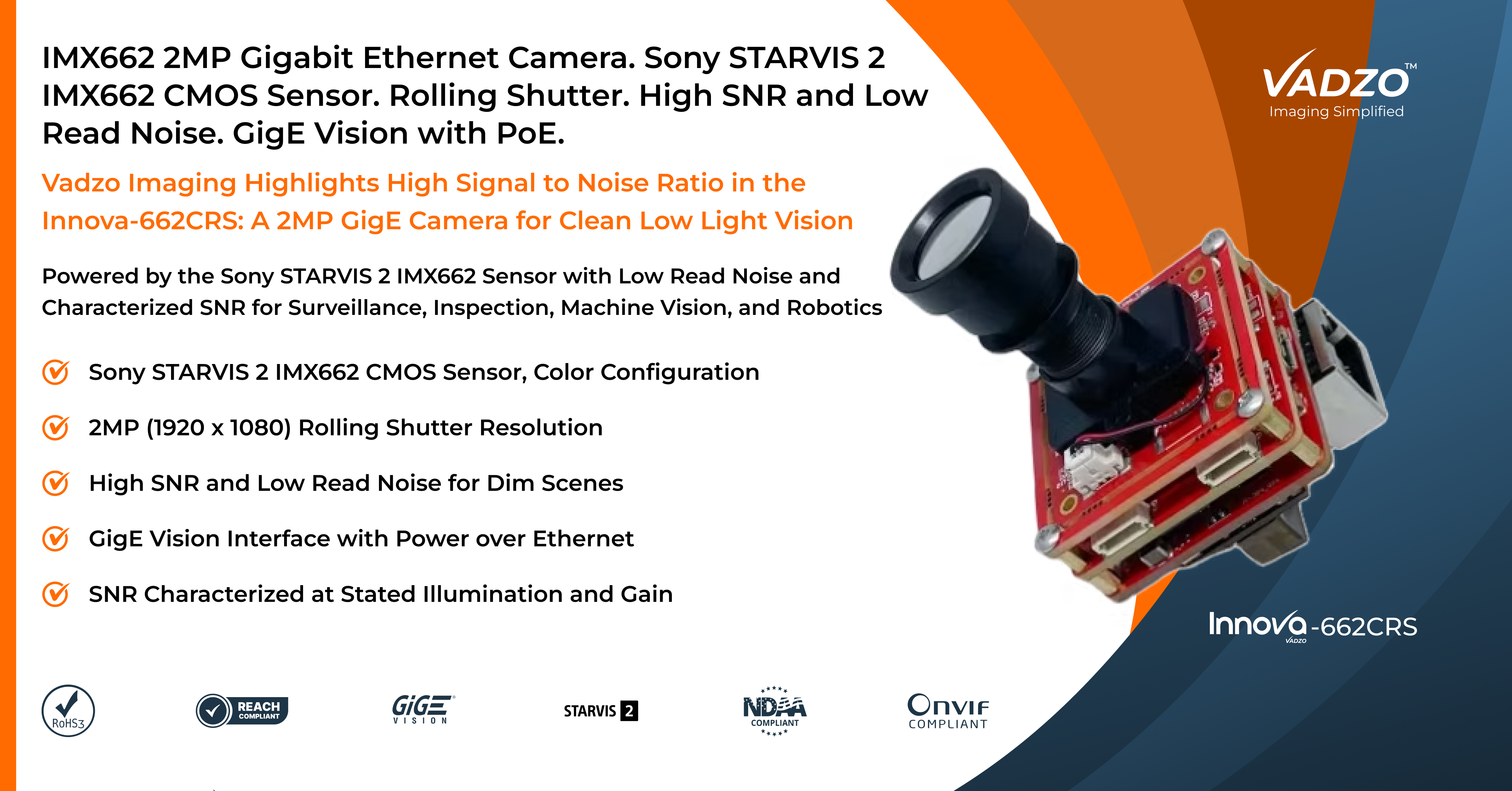
Innova-662CRS: Sony Starvis 2 IMX662 2MP GigE Camera for Signal-to-Noise Ratio
The Innova-662CRS is an IMX662 2MP Gigabit Ethernet Camera built on the Sony STARVIS 2 IMX662 sensor and described for high signal-to-noise ratio in low-light vision. As a Sony IMX662 SNR Sensor, it is built for integrators who want to compare noise performance under stated conditions rather than rely on a brightness demonstration. The STARVIS 2 High SNR Camera designation reflects Vadzo’s evaluation of noise across illumination and gain settings before the module reaches customers. The camera houses the sensor, ISP, and GigE Vision interface with Power over Ethernet in a compact body with an M12 lens mount. As an IMX662 Low Noise GigE Sensor, it outputs 1080p video, and the IMX662 Gigabit Ethernet Camera designation confirms operation across the supported output modes. As an IMX662 SNR GigE Module, it responds to standard GenICam controls, so exposure, gain, and processing settings can be managed from existing vision software.
Key specs: 2MP (1920 x 1080) Max Resolution | Sony STARVIS 2 IMX662 1/2.8 inch Sensor Format | 2.9 micron Pixel | Color with Rolling Shutter | GigE Vision Interface with PoE | M12 Lens Mount
Key Capabilities of the Sony STARVIS 2 IMX662 High SNR Gigabit Ethernet Camera
High SNR GigE Camera Image Quality in Dim Scenes
Dim scenes are where noise decides the outcome. As a High SNR GigE Camera, the Innova-662CRS starts with a strong signal, so an integrator needs less gain to reach a usable brightness. Lower gain means less amplified noise, which leaves more detail for recognition and measurement software. As a High Signal-to-Noise Ratio Camera, the module comes with characterization at stated conditions, so teams can place its performance on the same chart as other candidates and decide with data. Procurement and engineering teams can also attach the curves to a qualification report, which makes later audits simpler.
Low Noise GigE Camera Benefits for Compression and Analytics
Noise is expensive downstream. A Low Noise GigE Camera gives recorders and analytics a cleaner stream, which compresses at a lower bitrate for the same quality and triggers fewer false detections. Across a site with dozens of camera units, the savings in network and storage capacity can be meaningful. Analytics tuned on clean footage also behave more predictably, since thresholds do not need to be set high enough to ignore noise and risk missing real events. Recording systems also benefit from steadier image statistics, which help their encoders hold a consistent quality.
2MP High SNR GigE Camera Pixel Design
Pixel design underlies the ratio. A 2MP High SNR GigE Camera built on 2.9 micron pixels gathers more light per pixel than a higher resolution sensor of the same size, and it trades pixel count for cleaner pixels. As a 1080P high-SNR camera, the module delivers full high-definition output where many applications need it, and it avoids the extra noise that tiny pixels would add in dim light. For many surveillance and inspection tasks, a clean 2MP frame is more useful than a noisy larger one. Teams that need more pixels can crop or add a camera position, and still keep each view clean.
Low Read Noise GigE Sensor Behavior at Low Gain
Low read noise keeps dim scenes usable at modest gain. As a Low Read Noise GigE Sensor, the module holds electronic noise down so that photon-limited performance dominates, and as a 1080P Low Noise GigE Camera, it keeps the benefit at the resolution most systems use. The 2MP Low Noise Ethernet Sensor behavior also helps when software applies its own denoising, since a cleaner input needs less aggressive filtering and leaves less ghosting and softening behind. Light denoising also preserves the fine texture that recognition models use to tell objects apart.
Clean Image Low-Light GigE Performance with PoE
A camera that delivers a Clean Image Low-Light GigE stream must keep its own electronics quiet. Vadzo checks image noise with Power over Ethernet active, since power conversion is a known source of noise in compact camera designs. A PoE High SNR Camera lets installers run a single cable for data and power to ceilings, poles, and machines, and Vadzo validates that the convenience does not cost image quality. Teams should still evaluate noise in the actual enclosure, because heat and mounting also influence the result. A short test in the real housing, at the real temperature, is the most reliable guide.
ONVIF-Compliant GigE Camera for Network Video Integration
The Innova-662CRS supports ONVIF-based integration for network video systems, allowing integrators to incorporate the camera into compatible surveillance and video-management environments. Combined with GigE connectivity and PoE, ONVIF support helps simplify deployment across networked camera installations where interoperability with compatible video management and monitoring systems is required.
“Everyone says their camera works in low light, and a bright demo image proves very little. The question that matters is how much noise comes with that brightness. Integrators told us they could not compare vendors because every datasheet quoted a signal-to-noise figure under different conditions, or none at all. The Innova-662CRS pairs a low-noise sensor with an honest description of its noise at stated illumination and gain. We also check noise with Power over Ethernet running, because the power path can matter. Our aim is to give integrators numbers they can trust and compare, and a starting image clean enough for their software to work well. If a customer measures something different in their own setup, we want to know, because that is how the guidance gets better.” – Alwin Vincent, Product Manager, Vadzo Imaging.
Application Specific Sections: High SNR GigE Camera Systems in Practice
High SNR Surveillance GigE Camera for Continuous Monitoring
Surveillance systems record continuously, so noise affects both the quality of evidence and the cost of storage. The Innova-662CRS works as a High SNR Surveillance GigE Camera that gives recorders a cleaner stream, and its role as a Low Noise Security GigE Camera reduces false motion alerts caused by speckle at night. Operators gain more dependable alerts and lower bitrate for the same visual quality. Sites with many camera positions notice the effect most, since small savings per stream add up across the whole network. Fewer false alerts also mean less time spent by security staff reviewing events that turn out to be noise.
Low Noise Night Vision GigE for Dim Light Vision Ethernet Camera Systems
Nighttime and dim interior monitoring depend on how much usable detail survives in dark scenes. The module serves as a Low Noise Night Vision GigE installation when paired with whatever supplementary lighting the site provides, and its role as a Dim Light Vision Ethernet Camera supports long cable runs over standard Ethernet. As a High SNR Low-Light Vision Camera, it gives analytics a cleaner image to work from through the night. Sites that add illumination later find the module scales with it, since a clean starting image improves further with more light. Planners can therefore add illumination in stages without replacing the camera.
Low-Light Inspection GigE Sensor for Production Stations
Inspection stations sometimes operate with limited lighting because of heat, glare, or process constraints. The camera works as a Low-Light Inspection GigE Sensor where lower noise improves repeatability, since edges and defects stay stable from one capture to the next. Because the rolling shutter reads row by row, teams should match exposure and motion to the line, using indexed stations or short exposures for moving parts. Short exposures raise the need for gain, which is exactly where a clean starting signal pays off. Quality teams can also store the clean frames as a reference record for later review.
High SNR Machine Vision GigE for Measurement and Guidance
Measurement and guidance tasks depend on stable edge positions. The Innova-662CRS serves as a high-SNR machine vision GigE camera in stations that locate parts, read features, and check positions, with a cleaner image that reduces the jitter noise added to measurements. GigE Vision and GenICam keep it compatible with common machine vision software, so integration follows familiar steps. Teams that already run GigE Vision stations can add the module without changing their network design.
High SNR Robotics GigE Camera for Autonomous Platforms
Mobile robots move between bright and dim areas and cannot always stop to wait for a good exposure. The module functions as a High SNR Robotics GigE Camera that supplies navigation and detection software with a cleaner image in dim corridors and warehouses, using a single cable that carries data and power. Robots with limited onboard computing benefit particularly, because a clean input leaves more of the compute budget for perception instead of denoising. Fewer wasted cycles also mean lower power use, which extends battery life on mobile platforms.
Frequently Asked Questions About High SNR GigE Camera Systems
Q: What does a High Signal Noise Ratio Camera actually measure?
A: Vadzo Imaging explains it simply: the signal-to-noise ratio compares the strength of the useful image signal with the strength of random noise, usually expressed in decibels at a stated light level and gain. A higher ratio means the picture is cleaner. Because the figure changes with illumination, gain, exposure, and temperature, Vadzo Imaging recommends comparing curves measured under the same conditions instead of a single headline number, and it publishes the conditions alongside the figures.
Q: Why does a Low Noise GigE Camera matter for video compression and analytics?
A: Noise is hard to compress, so a noisy stream needs a higher bitrate to hold the same quality, which raises network and storage costs across a site. Noise also creates false detections in analytics and instability in measurements. Vadzo Imaging designs and describes this camera so integrators start from a cleaner image, which reduces the processing needed afterward and leaves more of the host budget for the application itself.
Q: Why does a Low Read Noise GigE Sensor matter more in dim scenes?
A: Every pixel readout adds a small fixed amount of electronic noise. In bright scenes, the signal is large, and that noise is insignificant, but in dim scenes it becomes a large share of the result. A sensor with low read noise keeps that share small, so a dim scene stays usable at lower gain. Vadzo Imaging evaluates the module at several illumination levels so integrators can see this effect in their own range of use.
Q: Does Power over Ethernet affect image noise on a PoE High SNR Camera?
A: It can, depending on the design, because power conversion is a known source of noise in compact camera designs. Vadzo Imaging checks image noise with Power over Ethernet active instead of assuming it makes no difference. Teams should still evaluate noise in their actual enclosure and mounting, since heat also influences results, and Vadzo Imaging supports that evaluation.
Q: Why should integrators choose Vadzo Imaging as their High SNR GigE Camera Supplier?
A: Vadzo Imaging offers more than a camera module built around a capable sensor. Integrators working with Vadzo Imaging receive a camera whose noise behavior is described under stated conditions, along with plain guidance on gain, exposure, and the limits of what any sensor can do, plus engineering support for lens selection, firmware customization, and enclosure design. Vadzo Imaging maintains evaluation kits with no minimum order requirement, so teams can measure noise with their own lighting before committing to volume production. That combination of transparency and low evaluation barriers is why integrators continue to choose Vadzo Imaging for low-light camera programs.
Availability
The Innova-662CRS IMX662 2MP Gigabit Ethernet Camera built on the Sony STARVIS 2 IMX662 sensor is available now for evaluation and production orders. Evaluation kits include the camera module, M12 lens, GigE cable, PoE injector, and configuration documentation, with no minimum order requirement. Integration teams can measure noise at their own illumination levels, gain settings, and mounting conditions before committing to a production bill of materials, which tells them more than a datasheet comparison alone. Teams can also compare the module against other candidates under identical conditions, using the same scene, the same lens, and the same gain, which is the only way to make a fair comparison. Vadzo is glad to review the results with a team and to suggest changes to exposure, gain, or lighting that improve them. Browse the full range of GigE camera options at Vadzo’s website or contact Vadzo at support@vadzoimaging.com to request an evaluation unit or discuss OEM integration requirements for surveillance, inspection, machine vision, and robotics camera programs.
About Vadzo Imaging
Vadzo Imaging is a global provider of embedded vision solutions and delivers high-performance camera technologies and imaging platforms for applications in robotics, industrial automation, UAVs, edge AI, and medical systems. Its products are designed for seamless integration with leading embedded platforms. Vadzo supports customers through hardware customization, firmware development, and module-level drivers, enabling faster development and deployment of vision-based systems across GigE, USB, MIPI, Wi-Fi, and SerDes camera interfaces.
Media Contact
Alwin Vincent
Vadzo Imaging
Email: alwin@vadzoimaging.com
LinkedIn: Vadzo Imaging
YouTube: Vadzo Imaging
X: Vadzo Imaging
SOURCE: Vadzo Imaging
View the original press release on ACCESS Newswire
Media gallery