
MCPU Polymer Engineering Introduces ‘Biocongruent Chemistry,’ a New Framework for Sustainable Polymers, at Polycon 2026
Soy- and lignin-based additives replace halogenated flame retardant TCPP in polyurethane insulation foam and improve
Press Release Disclaimer: This is a press release distributed through the XPR Media network. It has not been independently verified by our newsroom.
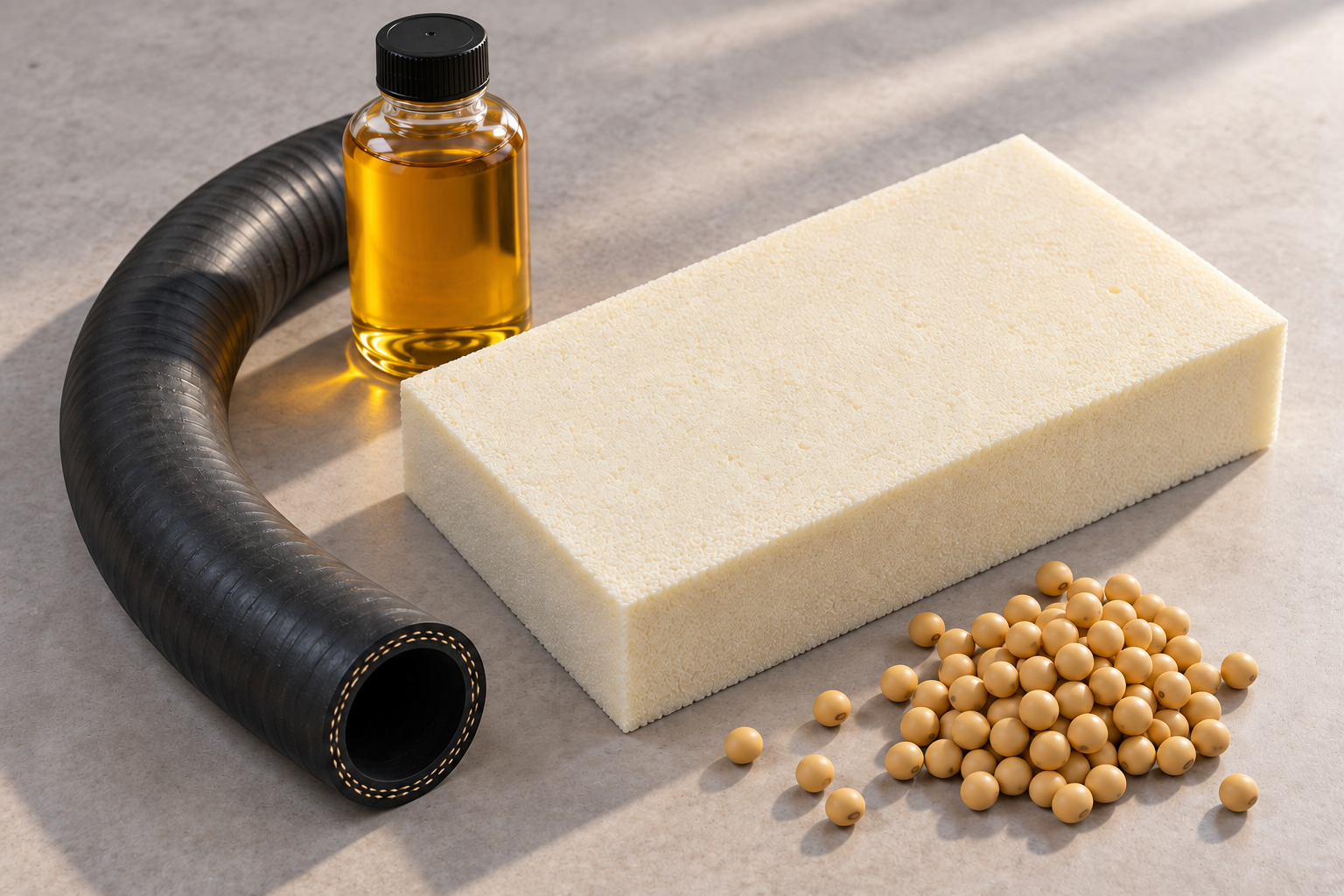

Soy- and lignin-based additives replace halogenated flame retardant TCPP in polyurethane insulation foam and improve end-of-life biodegradation.
PITTSBURG, KS, UNITED STATES, September 29, 2026 /EINPresswire.com/ — MCPU Polymer Engineering, LLC, a developer of bio-based reactive additives for polyurethanes for more than 20 years, will introduce a new materials design framework called biocongruent chemistry at the Center for the Polyurethanes Industry (CPI) 2026 Polyurethanes Technical Conference, October 5–7 at the Omni Orlando Resort at ChampionsGate in Orlando, Florida. The framework will be unveiled in a technical paper at 8:30 a.m. on Wednesday, October 7.
Biocongruent chemistry replaces 10 to 15 parts of a conventional polyol with soy-, lignin- or silicone-derived additives inside a proven polymer system. In the data MCPU will present, that swap eliminated the halogenated flame retardant TCPP from a commercial insulation foam with no loss of insulation value or mechanical performance, and increased biodegradation in soil-burial and field testing while the material stayed structurally intact. MCPU manufactures the additives and is commercializing the framework with foam, elastomer, adhesive and coating formulators; the underlying research was conducted with the Gogte Institute of Technology (Belgaum, India) and the National Institute for Materials Advancement (Pittsburg, Kan.), together with Purosil LLC and LCA Design.
“The industry has been told it must choose between performance and sustainability, and our data says that is a false choice,” said Thomas M. Garrett, Ph.D., CEO and Research Director of MCPU Polymer Engineering. “A manufacturer can keep the service life its customers pay for, drop the halogenated flame retardants its regulators are scrutinizing, and change how the material behaves when it reaches a landfill without reformulating from scratch. We developed the science with our research partners, and are now the ones bringing the solutions to market.”
Key findings to be presented include:
• A halogen-free path to replacing TCPP. In a commercial rigid polyisocyanurate (PIR) insulation foam, replacing 15 parts of conventional polyester polyol with MCPU’s phosphorylated soy-based additive matched the flame-retardant performance of TCPP under DIN 4102 (B2) testing — while thermal R-value, yield stress, density and foam processing characteristics remained effectively unchanged relative to the fossil-based control.
• Class I-comparable flame performance in carpet backing. A blend of MCPU’s soy additive with a non-halogenated phosphate flame retardant, replacing 20 parts of polyol and filler in a polyurethane carpet backing, matched the flame-spread performance of a Class I-rated commercial carpet.
• Faster biodegradation, intact structure. In soil-burial studies, PIR foams containing soy- and lignin-based polyols showed increased mass loss relative to fully petroleum-based systems while substantially retaining measured mechanical properties. Field exposure of soy-modified polyurethane elastomers under wastewater treatment conditions showed measurable degradation over 112 days without meaningful loss of mechanical properties.
• Durability cuts lifetime carbon by two-thirds. A cradle-to-grave life cycle assessment conducted to ISO 14040/14044 by LCA Design found that, when normalized for service life and replacement frequency, a biocongruent silicone rubber heater hose carried roughly one-third the lifetime carbon footprint of its EPDM counterpart.
The framework arrives as manufacturers face regulatory pressure on persistent chemistries, including PFAS and halogenated flame retardants, alongside customer demand for products that are safe, circular and economical. Biocongruent materials fill the gap between fossil-based polymers that persist in the environment for centuries and fully bio-based materials that can degrade prematurely in service.
“The question isn’t whether we can make a polymer disappear quickly,” said Saeed Fosshat, Research Staff Scientist at MCPU and lead author of the paper. “It’s whether we can make the material customers actually need, let it perform for its full service life, and still give nature something it can work with when that life is over.”
The paper, Biocongruent Chemistry, is co-authored by Saeed Fosshat, Enoch K. Acquah, Xian Xian Du and Thomas M. Garrett of MCPU Polymer Engineering; Andrew H. Garrett of Purosil LLC (Corona, Calif.); and Katie Soulliere of LCA Design (Windsor, Ontario). The full paper, including test data and life cycle assessment methodology, will be available to conference attendees and on request from MCPU following the presentation.
About MCPU Polymer Engineering, LLC
Founded in 1937 as the research arm of the W.S. Dickey Clay Company, MCPU Polymer Engineering has manufactured polyurethanes since the late 1950s and has developed bio-based reactive additives for polyurethane systems for more than 20 years. Headquartered in Pittsburg, Kansas, MCPU works with manufacturers in foam, elastomer, adhesive and coating applications on practical approaches to reducing reliance on fossil-derived polyols and halogenated flame retardants while maintaining commercial performance. Learn more at mcpupolymers.com.
Gustavo Lomas
MCPU Polymer Engineering, LLC
+1 512-228-8633
glomas@mcpu.net
Legal Disclaimer:
EIN Presswire provides this news content “as is” without warranty of any kind. We do not accept any responsibility or liability
for the accuracy, content, images, videos, licenses, completeness, legality, or reliability of the information contained in this
article. If you have any complaints or copyright issues related to this article, kindly contact the author above.

Media gallery


